Now Reading: ChatGPT vs Bard vs Copilot: Which AI Chatbot Wins?
-
01
ChatGPT vs Bard vs Copilot: Which AI Chatbot Wins?

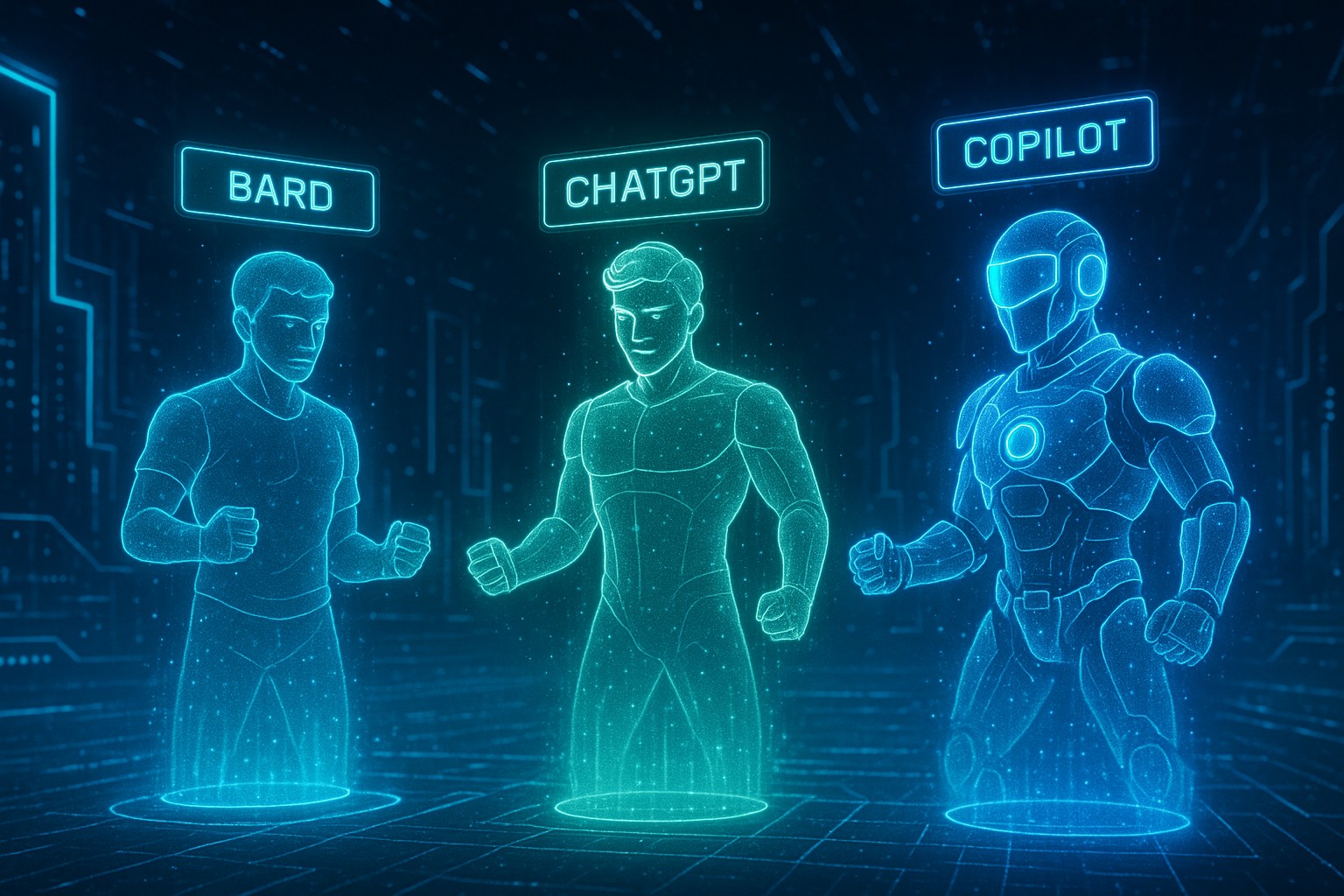
ChatGPT vs Bard vs Copilot: Which AI Chatbot Reigns Supreme?
Description: Compare ChatGPT with other leading AI chatbots like Google Bard, GitHub Copilot, and Perplexity. Learn their strengths in language generation, conversational AI, and how each tool is used. This analysis covers architectural approaches, typical workflows, integration points, and practical guidance for selecting the right tool for business contexts, development teams, and knowledge workers.
- copilot vs chatgpt
- chatgpt vs bard
- bard vs chatgpt
- chatgpt vs perplexity
- chatgpt competitors
Overview of the Competitive Landscape
In the current AI assistant market, four prominent players frequently appear in enterprise discussions and developer workflows: ChatGPT from OpenAI, Bard from Google, GitHub Copilot as an AI-powered coding assistant, and Perplexity as a search-oriented conversational agent. Each tool emerged to address a distinct need within the broader category of conversational AI, and they have since evolved through iterations that emphasize different dimensions such as language fluency, real-time information retrieval, coding support, and data governance. ChatGPT positions itself as a general-purpose conversational AI with a broad knowledge base and a strong emphasis on natural language understanding and generation. Bard, with its lineage tied to Google’s search and knowledge infrastructure, leverages live information and integration with search results to improve factual accuracy and up-to-date responsiveness. Copilot focuses on code generation, software development workflows, and IDE-integrated productivity, turning natural language prompts into executable code, snippets, and documentation. Perplexity emphasizes fast, search-driven answers, leveraging web references and structured responses to help users find, compare, and verify information quickly.
As a result, the tools map to different primary use cases: ChatGPT excels in drafting content, explanations, brainstorming, and multi-domain dialogue; Bard supports web-based knowledge tasks, dynamic fact-finding, and integration with Google’s ecosystem; Copilot is the go-to for developers seeking to accelerate coding, debugging, and learning programming patterns; Perplexity serves as a research-facing assistant that surfaces sources and clarifications. The market thus rewards complementary capabilities—organizations often deploy a mix of these tools to cover both general-purpose conversation and specialized workflows. This section highlights how these tools compete for attention, and how an organization can think about balancing generalist conversational quality with task-specific precision.
From a product strategy perspective, the competition centers around four axes: accuracy and reliability of responses, access to fresh information, integration and extensibility within existing tooling ecosystems, and control over data privacy and enterprise governance. ChatGPT has focused on improving its dialog continuity, safety controls, and plugin ecosystems to extend capabilities; Bard has anchored its value in live search and integration with Google services; Copilot has differentiated itself by deeply integrating with development environments and language models tuned for code; Perplexity emphasizes concise, sourced answers that help users verify claims rapidly. For business buyers, understanding where each tool shines—and where it might fall short in regulated environments or mission-critical tasks—is essential for designing a toolchain that minimizes risk while maximizing productivity.
Core Capabilities and Language Generation
All four platforms rely on large language model (LLM) technology as their foundation, but they diverge in how they optimize, train, and deploy these models for language generation. ChatGPT uses a multi-turn conversational framework that supports context retention across turns, enabling coherent, context-rich responses and the ability to follow complex instructions. It emphasizes safety, guardrails, and content moderation, aiming to produce helpful but non-harmful outputs. Bard leverages a blend of model-based generation and live data retrieval, which enables it to answer questions with up-to-date information and explicit citations. Copilot translates natural-language intents into code, comments, and documentation, with a focus on developer productivity, code correctness, and adherence to best practices. Perplexity prioritizes concise, query-driven answers augmented with source references to accelerate verification and further reading.
In practical terms, the language generation capabilities translate into different user experiences. ChatGPT is strong for long-form writing, structured content, and nuanced explanations that require reasoning, analogies, or step-by-step logic. Bard’s language generation is typically interwoven with real-time information and external references, producing responses that resemble an informed reader’s synthesis of web sources. Copilot’s generation is highly technical and task-oriented, producing code blocks, inline comments, and API usage patterns that fit within a developer’s workflow. Perplexity’s outputs are compact and citation-rich, designed to help users validate information via sources rather than delivering extensive, opinionated essays. The trade-off often hinges on time-sensitivity (live data vs. static knowledge), citation practices, and the user’s tolerance for conservatism in generated content.
From a performance perspective, all these platforms must strike a balance between fluency (smooth, natural language), factual accuracy (grounded in sources when possible), and safety (mitigating harmful or biased outputs). ChatGPT and Bard have explored tool-augmented generation—using plugins or integrations to pull in data, run computations, or access external services—while Copilot and Perplexity emphasize retrievable, reproducible outputs (code or sources). In regulated industries, the ability to lock down training data, monitor prompts, and audit usage becomes as important as raw linguistic capability. This section also underscores the importance of model alignment—how well the system’s outputs align with user intent and organizational policy—and how it changes with updates, plugins, and evolving data sources.
Finally, language generation quality must be evaluated against real-world tasks. For content generation, ChatGPT often offers coherent tone, structure, and variant styles suitable for professional communications. For technical content, Copilot’s integration with editors like VS Code can dramatically reduce boilerplate, tests, and repeated coding tasks, while Bard’s live data can ensure you’re not asking about yesterday’s events when you need today’s numbers. Perplexity’s citations empower researchers to trace ideas back to sources, which is valuable in knowledge-intensive tasks where traceability matters. The practical effect is that teams should match the tool to the task: broad narrative writing with ChatGPT, data-tue-updates and search-backed answers with Bard, code-first workflows with Copilot, and source-backed research with Perplexity.
Conversational UX and Interaction Models
The way a user interacts with an AI assistant—its memory, its sense of context, and how it handles follow-up questions—shapes the overall value of the system. ChatGPT emphasizes robust multi-turn dialogue, where the model can recall user-provided preferences within a session, maintaining thread coherence and enabling iterative refinement. It also implements safety and safety-related features to avoid dangerous or deceptive content, which is important for enterprise adoption and customer-facing use. Bard emphasizes a conversational style that integrates directly with live search, enabling users to ask questions they would typically type into a search engine and receive synthesized answers with cited sources. The UX thus blends dialog with navigable search results, links, and contextual hints that help users decide where to dive deeper.
Copilot’s interaction model is deeply integrated into the developer workflow. It reads the code context, project structure, and comments to generate code, tests, or documentation directly in the editor. This environment-centric approach reduces cognitive load and supports rapid iteration. It also introduces the concept of “explain-this-code” or “rewrite-this-function” prompts that align with developer tasks, rather than free-form chat. Perplexity focuses on concise responses and fast lookup, providing short answers augmented by references; its UX favors quick, scannable results and easy navigation to primary sources. Across all platforms, there is an increasing emphasis on controllability—giving users options to adjust tone, verbosity, and citation levels—to fit professional contexts, compliance requirements, and branding guidelines.
From a practical standpoint, the choice between these interaction models depends on the user persona and the task at hand. For a content team drafting a white paper, ChatGPT’s dialog management and stylistic controls can be valuable. For a software engineer writing and reviewing code, Copilot’s editor-integrated prompts deliver direct benefits with minimal switching between tools. For researchers needing timely information with sources, Perplexity offers a fast, citation-backed flow. For a business analyst preparing a market briefing that blends data from multiple sources, Bard can streamline information retrieval and synthesis within the context of current events. The common thread is that conversational UX is not a single feature but a set of linked capabilities that determine how effectively the tool integrates into daily workflows.
Use Cases and Industry Fit
Different sectors and roles benefit from targeted capabilities. In content creation and marketing, ChatGPT shines at producing drafts, outlines, and communication materials at scale, with the ability to tailor voice and audience. It also supports translation workflows and multilingual content generation, which is valuable for global teams. Bard, with its emphasis on current information, is particularly useful for market intelligence tasks, competitive analysis, and customer support scenarios that require up-to-date factual responses. Copilot is a natural fit for software development teams—writing code snippets, unit tests, and documentation as part of daily coding sessions. It can also assist in learning new programming languages and paradigms by demonstrating examples in-context. Perplexity serves research-heavy workflows where verifying information and obtaining primary sources quickly is essential, such as academic research, policy analysis, and journalism.
Within enterprise environments, these tools can be combined to cover a wide range of tasks while meeting governance and compliance requirements. For example, a product team might use Copilot to accelerate feature development, ChatGPT to draft user guides and release notes, Bard to keep the team informed on current industry trends, and Perplexity to verify claims and collect citations for a briefing deck. In customer support, a hybrid approach could involve Bard powering live knowledge queries, with ChatGPT handling complex triage conversations and escalation notes to human agents. For data privacy and security, enterprises often require clear boundaries between training data and enterprise data, control over model access, and mechanisms to audit prompts and outputs. This section emphasizes that practical adoption hinges on architecture choices, integration depth, and governance frameworks as much as on raw capability.
From a developer productivity perspective, Copilot offers measurable benefits through auto-generated boilerplate, API usage patterns, and inline explanations. It can significantly shorten onboarding time for new languages or frameworks, while maintaining security and style guidelines with configurable templates. ChatGPT can support training, internal knowledge bases, and policy explanations, enabling new hires to access an AI-guided onboarding experience. Bard’s real-time data advantages can augment dashboards, status reports, and executive summaries with the latest numbers and citations. Perplexity’s strengths lie in fact-checking and literature reviews, helping teams quickly surface credible sources. Organizations should map these capabilities to the problem statements they face, rather than treating AI tools as a one-size-fits-all solution.
Strengths, Limitations, and Trade-offs
Each platform has unique strengths and trade-offs that influence deployment decisions. ChatGPT’s strengths include strong general-purpose language capabilities, coherent long-form generation, and a flexible platform that supports plugins and integrations. Its limitations often relate to facts that may be outdated unless refreshed by tools with live data access, and to the need for careful prompt design to achieve precise outcomes. Bard’s primary strengths are access to fresh information and citations, which improve trust in factual claims and support quick decision-making. Its limitations may include variability in answers when sources disagree, and dependence on live web data that can introduce extraneous noise if not managed properly. Copilot’s strengths revolve around developer productivity, contextual code generation, and the ability to operate inside the editor with minimal switching cost. Its limitations include domain-specific correctness in niche languages or frameworks, potential overreliance on pattern matching, and the need for human review of generated code. Perplexity’s strengths are concise, source-backed responses that facilitate verification and learning, while its limitations may involve shorter outputs that require additional prompts to obtain depth, or reliance on the availability and reliability of cited sources.
From an implementation perspective, trade-offs often center on data privacy, training data governance, and the balance between real-time information versus historical knowledge. For compliance-conscious organizations, the ability to isolate training data from enterprise data, define retention policies, and audit model behavior becomes critical. In terms of performance, the choice may come down to the desired balance between speed and accuracy, language support, and the integration surface available (APIs, plugins, or IDE extensions). A pragmatic approach to tool selection involves a tiered strategy: use Copilot for code-centric tasks, ChatGPT for documentation and content tasks, Bard for dynamic information retrieval within Google’s ecosystem, and Perplexity for research-oriented fact-checking and source tracing. This combination can cover a broad spectrum of business needs while mitigating platform-specific weaknesses.
Finally, governance and risk management should guide tool adoption. Organizations should implement usage policies, data handling guidelines, and monitoring frameworks to track AI-assisted outputs, detect anomalies, and provide human-in-the-loop validation for high-stakes decisions. A well-designed AI strategy also considers procurement options—whether to deploy managed services, enterprise-grade plans with data residency features, or on-premises/offline modes—and how these choices align with regulatory requirements and industry standards. In short, successful adoption hinges not just on the strength of the underlying models, but on how well tools integrate into established workflows, policies, and risk controls.
Integration, Ecosystem, Pricing, and Privacy Considerations
Integrations define the practical utility of AI assistants in professional environments. ChatGPT has built a broad ecosystem around plugins, API access, and enterprise features that enable workflows across CRM, analytics, content management, and custom tooling. The plugin model enables specialized capabilities such as data retrieval, actions in external systems, and domain-specific tooling, which can dramatically extend what a chat-based assistant can accomplish. Bard emphasizes integration with Google Workspace and related services, promoting seamless workflows within familiar productivity apps. Copilot’s ecosystem is rooted in developer tooling—integrations with major IDEs, code repositories, and CI/CD pipelines—driving a strong alignment with software delivery processes. Perplexity focuses on search and information retrieval workflows, and its ecosystem centers on query efficiency, source management, and rapid access to references.
Pricing models and accessibility influence adoption at scale. ChatGPT typically offers tiered subscription plans that unlock higher message limits, faster response times, and access to advanced features such as plugins or more capable models. Bard’s pricing and access are tied to Google’s platform strategies and may be bundled with existing Google services for enterprise users. Copilot pricing is often license-based or included as part of developer tooling packages, making it a natural fit for teams already investing in IDE-centric workflows. Perplexity tends to attract users who value fast lookups and concise outputs, with premium tiers offering enhanced features like deeper citation sets or offline capabilities. In all cases, enterprises will scrutinize data residency, retention, and the ability to control training data exposure to protect sensitive information and comply with privacy regulations.
Privacy and data governance are paramount in enterprise deployments. A key decision factor is whether user prompts are stored, used to train models, or retained for analytics. ChatGPT’s enterprise offerings typically provide configurable data handling policies and options to restrict model training on enterprise data, along with auditability features. Bard’s privacy posture is tied to Google’s broader data usage policies, requiring careful evaluation of how enterprise data is logged and used. Copilot’s integration with codebases raises considerations about source code exposure, licensing, and how sensitive repository data is treated in model prompts. Perplexity’s model for handling data and citations likewise matters for academic or policy-focused teams who require strict provenance and reproducibility. Organizations should implement role-based access controls, data loss prevention measures, and continuous monitoring to ensure AI usage remains compliant with external regulations and internal standards.
Operationally, teams must address monitoring, explainability, and incident response around AI-generated outputs. This includes setting expectations about answer quality, implementing guardrails to avoid unsafe or biased content, and establishing escalation paths when outputs require human review. It also means investing in training for staff to effectively prompt, interpret, and validate AI-assisted results, as well as maintaining documentation about the chosen toolchains, integration points, and governance policies. The end result is a well-governed AI environment where business goals are supported by transparent, controllable, and auditable AI capabilities that can scale across teams and use cases.
FAQ
How do these AI chatbots handle privacy and data usage?
Privacy and data usage vary by vendor and deployment model. ChatGPT enterprise offerings typically provide options to limit or exclude enterprise data from training and to configure data retention and access controls. Bard aligns with Google’s broader privacy policies, emphasizing data handling across Google services and user consent frameworks. Copilot processes code and related prompts within the editor and may be subject to enterprise governance and licensing terms that govern data exposure. Perplexity focuses on search-backed responses and citations, with privacy considerations tied to how query data is stored and whether it is used to improve models. In any case, organizations should implement clear data handling policies, restrict sensitive prompts, enable data residency options where available, and use monitoring to detect and mitigate any unintended data exposure. Human-in-the-loop controls and explicit training-data boundaries help ensure compliance with regulatory requirements and corporate privacy standards.
Which tool is best for coding and software development?
Copilot is the most specialized tool for coding and software development. It is deeply integrated into common IDEs, can generate code snippets, tests, and documentation, and tends to improve developer velocity by reducing boilerplate work and accelerating learning curves for new languages or frameworks. ChatGPT can assist with higher-level design discussions, explanation of algorithms, and writing code in a conversational manner, but it may require more manual integration when used in production workflows. Bard offers live web data, which can help with researching libraries or APIs, but its primary advantage is not code generation. Perplexity can help developers locate sources or documentation quickly, which supports research tasks during development. For a coding-centric workflow, Copilot combined with ChatGPT for design reviews and documentation tends to deliver the strongest end-to-end productivity gains, provided privacy and licensing considerations are managed properly.
How do these tools manage citations and factual accuracy?
Fact accuracy and citation practices differ. Bard emphasizes live data with explicit citations, making it a strong choice when up-to-date information and verifiability are critical. ChatGPT relies on its training data and can generate confident responses even when some information is outdated; it often benefits from plugins or retrieval tools to improve accuracy. Perplexity prioritizes citation-rich, source-backed responses intended to facilitate verification. Copilot’s outputs are code-focused and must be validated by developers, as generated code can contain logical or security issues. Across all tools, a best practice is to treat AI outputs as starting points, verify critical facts against primary sources, and provide citations wherever possible in delivery to maintain trust and accountability in professional contexts.
What are the best practices for integrating these tools into an enterprise workflow?
Best practices start with governance and risk assessment. Define which data can be used by AI tools, set retention and training rules, and implement access controls. Establish clear use-case policies to ensure AI outputs align with brand, legal, and compliance requirements. Build an integrated toolchain where Copilot handles coding, ChatGPT supports documentation and knowledge sharing, Bard augments research and data-gathering tasks, and Perplexity aids in literature review and citation management. Use monitoring and auditing to track prompts, outputs, and potential biases, and ensure a human-in-the-loop for high-stakes decisions. Finally, invest in training for staff on prompt engineering, output interpretation, and safe AI usage to maximize return while minimizing risk.
Can these tools work together, or should organizations pick one primary solution?
They can and often should be used in combination to cover a broader set of tasks and workflows. Each tool offers strengths in different domains, so a blended approach can maximize productivity and minimize risk. For example, Copilot can accelerate code development, ChatGPT can draft comprehensive documentation and policy explanations, Bard can assist with current events and live data-driven tasks, and Perplexity can provide rapid, source-backed insights for research or competitive analysis. The key to success is to orchestrate data governance, ensure consistent prompts and outputs, and establish interoperability between tools through standardized APIs and enterprise platforms. The decision to rely on multiple tools versus selecting a single primary platform should be driven by use-case requirements, security considerations, and the maturity of the organization’s AI governance framework.